

Lot 21


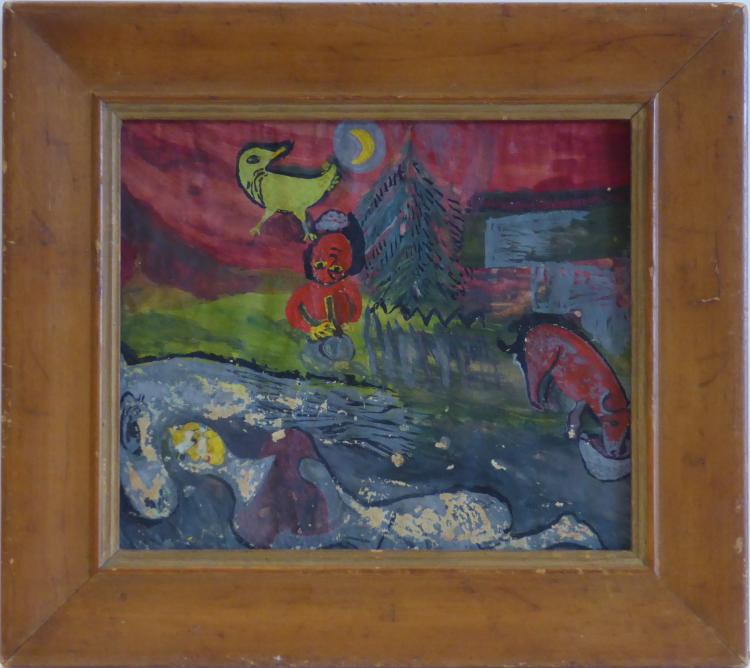


For your consideration this amazing gouache on paper in the manner of Marc Chagall. The painting is very old. We estimate a 1940's creation. It is coming with the original frame with provenance from New York. The painting measures 9.5" x 8". The original frame is 11.5" x 13". It is unsigned. Marc Chagall was a man of keen intelligence, a shrewd observer of the contemporary scene, with a great sympathy for human suffering. He was born on July 7, 1887 in Vitebsk, Russia; his original name was Moishe Shagal (Segal), but when he became a foremost member of the Ecole de Paris, he adopted French citizenship and the French spelling of his name. Vitebsk was a good-sized Russian town of over 60,000, not a shtetl. His father supported a wife and eight children as a worker in a herring-pickling plant. Sheltered by the Jewish commandment against graven images, the young Chagall never saw so much as a drawing until, one day, he watched a schoolmate copying a magazine illustration. He was ridiculed for his astonishment, but he began copying and improvising from magazines. Both Chagall's parents reluctantly agreed to let him study with Yehuda Pen, a Jewish artist in Vitebsk. Later, in 1906, they allowed their son to study in St. Petersburg, where he was exposed to Russian Iconography and folk art. At that time, Jews could leave the Pale only for business and employment and were required to carry a permit. Chagall, who was in St. Petersburg without a permit, was imprisoned briefly. His first wife, Bella Rosenfeld, was a product of a rich cultivated and intellectual group of Jews in Vitebsk. Chagall was made commissar for the arts for the area, charged with directing its cultural life and establishing an art school. Russian folklore, peasant life and landscapes persisted in his work all his life. In 1910 a rich patron, a lawyer named Vinaver, staked him to a crucial trip to Paris, where young artists were revolutionizing art. He also sent him a handsome allowance of 125 francs (in those days about $24) each month. Chagall rejected cubism, fauvism and futurism, but remained in Paris. He found a studio near Montparnasse in a famous twelve-sided wooden structure divided into wedge-shaped rooms. Chaim Soutine, a fellow Russian Jew, and Modigliani lived on the same floor. To Chagall's astonishment, he found himself heralded as one of the fathers of surrealism. In 1923, a delegation of Max Ernst, Paul Eluard and Gala (later Salvador Dali's wife) actually knelt before Chagall, begging him to join their ranks. He refused. To understand Chagall's work, it is necessary to know that he was born a Hasidic Jew, heir to mysticism and a world of the spirit, steeped in Jewish lore and reared in the Yiddish language. The Hasidim had a special feeling for animals, which they tried not to overburden. In the mysterious world of Kabbala and fantastic ancient legends of Chagall's youth, the imaginary was as important as the real. His extraordinary use of color also grew out of his dream world; he did not use color realistically, but for emotional effect and to serve the needs of his design. Most of his favorite themes, though superficially light and trivial, mask dark and somber thoughts. The circus he views as a mirror of life; the crucifixion as a tragic theme, used as a parallel to the historic Jewish condition, but he is perhaps best known for the rapturous lovers he painted all his life. His love of music is a theme that runs through his paintings. After a brief period in Berlin, Chagall, Bella and their young daughter, Ida, moved to Paris and in 1937 they assumed French citizenship. When France fell, Chagall accepted an invitation from the Museum of Modern Art to immigrate to the United States. He was arrested and imprisoned in Marseilles for a short time, but was still able to immigrate with his family. The Nazi onslaught caught Chagall in Vichy, France, preoccupied with his work. He was loath to leave; his friend Varian Fry rescued him from a police roundup of Jews in Marseille, and packed him, his family and 3500 lbs. of his art works on board a transatlantic ship. The day before he arrived in New York City, June 23, 1941, the Nazis attacked Russia. The United States provided a wartime haven and a climate of liberty for Chagall. In America he spent the war years designing large backdrops for the Ballet. Bella died suddenly in the United States of a viral infection in September 1944 while summering in upstate New York. He rushed her to a hospital in the Adirondacks, where, hampered by his fragmentary English, they were turned away with the excuse that the hour was too late. The next day she died. He waited for three years after the war before returning to France. With him went a slender married English girl, Virginia Haggard MacNeil; Chagall fell in love with her and they had a son, David. After seven years she ran off with an indigent photographer. It was an immense blow to Chagall's ego, but soon after, he met Valentine Brodsky, a Russian divorcee designing millinery in London (he called her Fava). She cared for him during the days of his immense fame and glory. They returned to France, to a home and studio in rustic Vence. Chagall loved the country and every day walked through the orchards, terraces, etc. before he went to work. Chagall died on March 28, 1985 in the south of France. His heirs negotiated an arrangement with the French state allowing them to pay most of their inheritance taxes in works of art. The heirs owed about $30 million to the French government; roughly $23 million of that amount was deemed payable in artworks. Chagall's daughter, Ida and his widow approved the arrangement. Written and submitted by Jean Ershler Schatz, artist and researcher from Laguna Woods, California. Sources: Hannah Grad Goodman in Homage to Chagall in Hadassah Magazine, June 1985 Jack Kroll in Newsweek, April 8, 1985 Andrea Jolles in National Jewish Monthly Magazine, May 1985 Michael Gibson in ARTnews, September 1988 Time Magazine, July 30, 1965 Biography from GallArt.com Born in Belarus in 1887, Marc Chagall was a French painter, printmaker and designer associated with several major artistic styles, synthesizing elements of Cubism, Symbolism and Fauvism. One work in particular, I and the Village (1911), pre-dated Surrealism as an artistic expression of psychic reality. An early modernist, Chagall created works in nearly every artistic medium, including sets for plays and ballets, biblical etchings, and stained-glass windows. Chagall died in France in 1985. Today, he is widely regarded as one of the most successful artists of the 20th century. EARLY YEARS Marc Chagall was born on July 7, 1887, in Vitebsk, Belarus (in the Russian Empire), and was raised in a devoutly Jewish environment with eight other siblings. His father worked in a fish warehouse, and his mother ran a shop where she sold fish and sundry baking supplies. As a child, Chagall attended heder (Jewish elementary school) and later went to public school, where lessons were taught in Russian. After learning the elements of drawing at school, from 1907 to 1910, Chagall studied painting in St. Petersburg at the Imperial Society for the Protection of the Arts, eventually under stage designer L_on Bakst. A characteristic work from this early period is "The Dead Man" (1908), a painting that depicts a violinist (a recurring image for the artist) amid a nightmarish rooftop scene. Chagall moved to Paris in 1910, and then moved into a studio on the edge of town in a Bohemian area known as La Ruche ("the Beehive"). There, he met several writers and artists, including Guillaume Apollinaire, Robert Delaunay and Albert Gleizes. In such artistic company, experimentation was encouraged, and Chagall quickly began developing the poetic and innovative tendencies that had begun to emerge in Russia at the timeÜtendencies that may not have previously been encouraged. At the same time, he came under the influence of the Impressionist, Post-Impressionist and Fauvist pictures he saw in Paris museums, and was introduced to Fauvism and Cubism. Before long, he was participating in the Salon des Ind_pendants and the Salon d'Automne (1912), annual French exhibits, staging his first solo show in 1914 in Berlin to great adulation. This periodÜduring which he created several images of his childhood and hometown of VitebskÜis considered Chagall's strongest, artistically, and the style he developed would remain with him for the rest of his life. His works during this time include "Hommage Apollinaire" (1911-12), The Fiddler (1912) and Paris Through the Window (1913). WORLD WAR I After the Berlin exhibition, Chagall returned to Vitebsk, Belarus, where he intended to stay long enough to marry his fianc_e, Bella. A few weeks later, though, he was stranded by the outbreak of World War I, as the Russian borders were closed indefinitely. Instead of despairing, Chagall embraced local scenes in his art, working at the time in an unusually realistic style. Paintings such as "The Praying Jew" (or The Rabbi of Vitebsk; 1914) and "Jew in Green" (1914) emerged during this period. Chagall married Bella in 1915, and the flying lovers of Birthday (1915-23) and the playful, acrobatic Double Portrait with a Glass of Wine (1917) serve as testaments to the joyousness of the artist's spirit during the early years of his marriage. At first, Chagall was enthusiastic about the Russian Revolution of October 1917, and he decided to settle in Vitebsk. In 1918, he was appointed commissar for art, and then founded and directed the Vitebsk Popular Art School. Disagreements with the Suprematists (a group of artists primarily concerned with geometric shapes) resulted in Chagall's resignation from the school in 1920, after which he moved to Moscow, there undertaking his first stage designs for the State Jewish Chamber Theater. Chagall then left Russia for good. After a stop-over in Berlin in 1922, the artist returned to Paris in 1923 with his wife and daughter; his first retrospective took place there the following year, at the Galerie Barbazanges-Hodebert. Chagall had learned engraving while in Berlin, and he received his first engraving commission in 1923, from Paris art dealer and publisher Ambroise Vollard, for creating etchings to illustrate a special edition of Nikolay Gogol's novel Dead Souls. Over the next three years, Chagall completed 107 plates for the Gogol book, 100 gouaches for poet Jean de La Fontaine's Fables, and a series of etchings illustrating the Bible; his career as a printmaker was in full swing. During the 1930s, besides painting and engraving, Chagall traveled extensively: to the Netherlands, Spain, Poland, Italy and Palestine, where he stayed for two months, visiting the Holy Land to inspire his Bible etchings. In Palestine in 1931, Chagall immersed himself in Jewish life and history, and by the time he returned to France, he had completed 32 of biblical plates (he would create 105 in total). WORLD WAR II With Hitler rising to power, a full-blown war was waged in Germany against artists, and, subsequently, anything deemed modern or difficult to interpret being confiscated and burned (with some of Chagall's works being singled out). The once-impressed German press now turned on Chagall, and in response, Chagall's paintings struck a different tone, with terror and persecution taking on foreground roles. In Solitude (1933), Chagall's anxiety over the fate of humanity is represented by an atmosphere of despondency and in the figure of the huddled, pious Jew; in White Crucifixion (1938), Jewish and Christian symbols are mixed in a depiction of a Nazi crowd terrorizing Jews. The artist would be dealt another blow in 1939, when Ambroise Vollard died and Chagall's various etching projects were put on hiatus. (Another publisher later picked up where Vollard had left off, issuing Dead Souls in 1948, La Fontaine's Fables in 1952 and the Bible in 1956.) With the outbreak of World War II, Chagall moved farther and farther south in France, as the Nazi threat became increasingly real for European Jews. A group of Americans ran a rescue operation trafficking artists and intellectuals out of Europe to the United States via forged visas, and Marc Chagall was one of more than 2,000 who escaped this way. He arrived in New York with Bella on June 23, 1941Üthe day after Germany invaded the Soviet UnionÜand spent most of the next few years in the New York area. In New York, Chagall continued to develop his signature themes, but in 1942, a new commission came his way: to design the sets and costumes for a new ballet, Aleko, by L_onide Massine, which would stage Pushkin's The Gypsies and be accompanied by the music of Tchaikovsky. When AlekoÜChagall's first balletÜpremiered on September 8, 1942, it was a great success. Also during this period, Chagall designed the backdrops and costumes for Stravinsky's ballet The Firebird (1945), another success. The course of Chagall's life and art was changed yet again in 1944, when his wife, Bella, passed away. Thereafter, depictions of memories of his wife recurred in Chagall's work; she appears in several formsÜa haunted weeping wife, an angel and a phantom brideÜin Around Her (1945), and as a bride in The Wedding Candles (1945) and Nocturne (1947). Before moving back to France for good in 1948, Chagall was honored with retrospective exhibitions at both the Museum of Modern Art in New York and the Art Institute of Chicago. LATER YEARS In 1948, Chagall settled again in France, on the French Riviera at Vence. During the 1950s, he forayed into painting and modeling ceramics, stone sculptures and mosaics. In 1958, Chagall designed the scenery and costumes for the ballet Daphnis and Chloe for the Paris Opera, from whom, five years later, he received a commission to paint a new ceiling for its theater. The choice of artist, however, stirred controversy, as some objected to having a French national monument redesigned by a Russian Jew, while others disliked the idea of a modernist working on such a historic building. Nonetheless, the project went forward with Chagall at the helm, and when it was unveiled, it was a huge hit with all factions, surprising many and vindicating others, Chagall included. Over Chagall's decades-long career, his use of color captured the attention of viewers, and his varying projects in his later years were no different: In 1960, he began creating stained-glass windows for the synagogue of Hebrew University's Hadassah Medical Center in JerusalemÜa project that became a spiritual journey for Chagall, once again linking him to his Jewish heritage. Chagall later took on more stained-glass projects, including at the United Nations building (1964); the Fraumªnster Cathedral in Zurich (1967); St. Stephen's Church in Mainz, Germany (1978); and the All Saints' Church in the United Kingdom (1978). Marc Chagall died in Saint-Paul de Vence, France, on March 28, 1985, leaving behind a vast collection of work in several branches of the arts, as well as a rich legacy as a major Jewish artist and a pioneer of modernism. Pablo Picasso famously once said of the artist, "When Matisse dies, Chagall will be the only painter left who understands what color really is." (Courtesy of Biography.com)
- Condition: It is in original condition as we found it.
Accepted Forms of Payment:
American Express, COD (cash on delivery), Discover, MasterCard, Money Order / Cashiers Check, Paypal, Personal Check, Visa, Wire Transfer
Shipping
Sometimes Artelisted will keep the option to bring the staff to a UPS Store. Buyer will pay handling, shipping, and insurance (if desired) costs. Shipping costs depends on final destination.
Sometimes the items are in the owner possession. In this case the shipping will be from a third party delivery.
In this case as a trusted third-party Artelisted collects, holds in an escrow account)and disperses payments once buyers and sellers are satisfied.
STEP 1
Final costs are calculated (including shipping), and the buyer submits payment through Paypal, Credit Card, or Wire Transfer.
STEP 2
After the payment is verified, the seller sends the painting within ten days. Artelisted ensures that paintings are sent with a tracking number. Insurance is purchased at the cost and discretion of the seller.
STEP 3
Enjoy your artwork.
If you are discontent you have five days, from the confirmed shipping delivery date, to send an email to [email protected]. If you choose to return the painting, you the buyer, will be responsible for shipping and shipping insurance costs.
All of the lots are originals with proven provenance. The works are not framed and the canvases may not be stretched for delivery purposes.
Artelisted
View full terms and conditions
| From: | To: | Increments: |
|---|---|---|
| $0 | $49 | $2 |
| $50 | $99 | $5 |
| $100 | $199 | $10 |
| $200 | $499 | $20 |
| $500 | $999 | $50 |
| $1,000 | $4,999 | $100 |
| $5,000 + | $200 |